
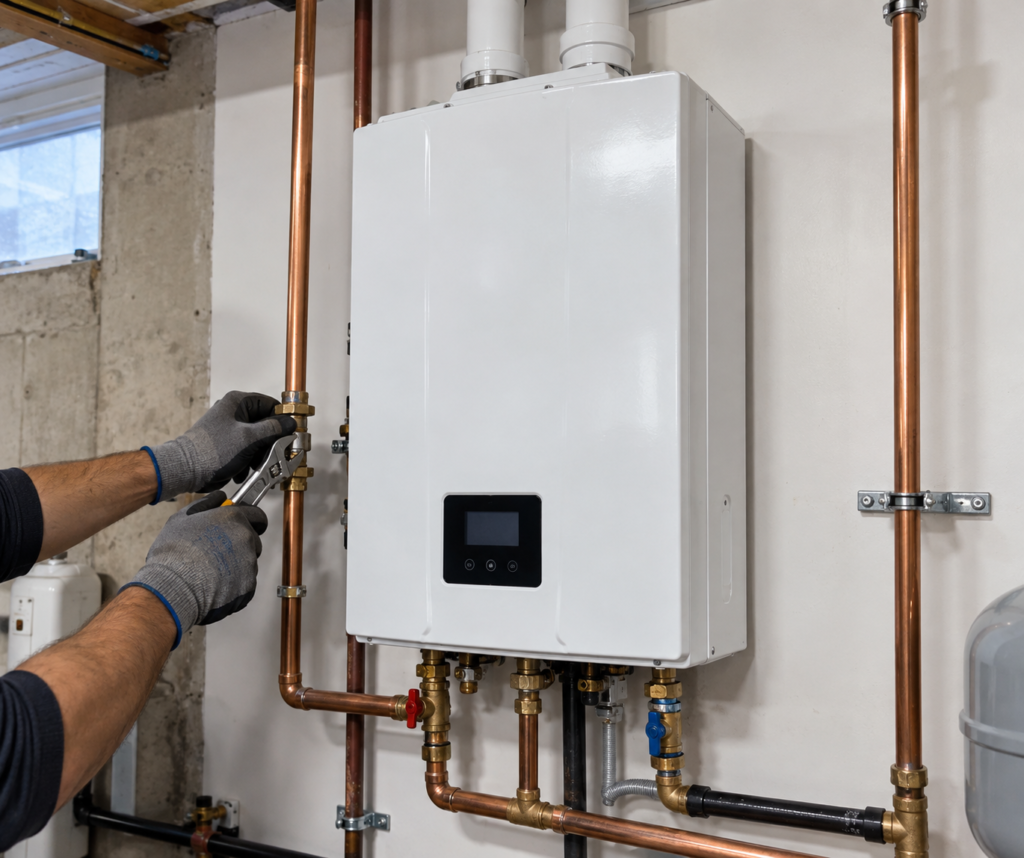
A tankless water heater is one of the best investments in a GTA home. It never runs out of hot water, uses significantly less energy than a tank, and lasts 20–25 years when properly maintained. That last part is the catch: properly maintained. A tankless unit that goes years without service quietly loses efficiency, and by the time the problem is obvious, it is either running at a fraction of its rated capacity or triggering fault codes that shut it down entirely.
This guide explains what tankless water heater service involves, how often it needs to happen, and what the warning signs of a neglected unit look like.
Why Tankless Water Heaters Need Annual Service in the GTA
The core problem is water hardness. The Greater Toronto Area and York Region are served by Lake Ontario source water that, after treatment, still contains enough dissolved calcium and magnesium to cause progressive scale buildup inside any appliance that heats water. The effect on a tankless water heater is specific and measurable: calcium carbonate deposits on the heat exchanger coils reduce heat transfer efficiency year over year. A unit that is running 20% below its rated output — entirely because of scale — feels like low water pressure or inconsistent hot water temperature, but the root cause is a heat exchanger that cannot deliver the same BTU transfer it could when it was new.
The harder the water, the faster the scale accumulates. In York Region communities including Richmond Hill, Vaughan, Markham, and Newmarket, the water hardness is high enough that annual descaling is not optional maintenance — it is what keeps the unit within its rated specifications.
What a Tankless Water Heater Service Includes
1. Heat Exchanger Descaling (the core service)
The heat exchanger is flushed with a diluted descaling solution — typically food-grade citric acid or a commercially formulated descaler — circulated through the coils for 45–60 minutes to dissolve calcium carbonate deposits. The flush removes the scale layer, restores heat transfer efficiency, and prevents the progressive narrowing of flow passages that eventually causes low pressure and fault shutdowns.
This is not a DIY service. It requires isolating the unit from the supply line, using a submersible pump to circulate the descaling solution, and confirming the unit’s recovery before restoring supply. Doing it incorrectly — using the wrong descaler, insufficient circulation time, or failing to neutralise and flush completely — can damage the heat exchanger rather than clean it.
2. Inlet Water Filter Cleaning
Most tankless water heaters have a small mesh filter on the cold water inlet connection. Over time, sediment, mineral particles, and debris from the supply line collect on this screen and restrict incoming water flow. A clogged inlet filter is one of the most common causes of apparent “low pressure” from a tankless unit — and one of the easiest to fix. We remove and clean or replace the filter screen at every service.
3. Condensate Drain Inspection (condensing units)
High-efficiency condensing tankless units produce acidic condensate as a byproduct of combustion. That condensate is routed to a drain through a small plastic trap and drain line. If the trap becomes blocked — with mineral deposits, debris, or a biological buildup — the unit triggers a safety shutdown. This is a common mystery fault that presents as the unit unexpectedly cutting out during use. Clearing the condensate drain is part of every service on condensing units.
4. Air Intake and Exhaust Inspection
Tankless water heaters draw combustion air and vent exhaust through one or two plastic pipes that run to the exterior of the building. Bugs, birds, and debris can partially block these vents, which affects combustion efficiency and can trigger safety codes. We visually inspect both the intake and exhaust terminations at every service call.
5. Error Code Review
Most modern tankless units maintain an error log. We pull the stored fault codes and review them even if the unit is currently running normally — intermittent faults that have not yet caused a shutdown are often predictors of the failure mode coming next. Catching a recurring fault code during a service visit is far better than catching it when there is no hot water.
How Often Does a Tankless Water Heater Need Servicing?
In GTA and York Region conditions: annually. This is consistent with every major manufacturer’s warranty requirements for areas with moderate to hard water.
Some installers and manufacturers say “every two years” in a general context. That interval is appropriate for areas with very soft water — not for the GTA. Waiting two years between descaling services in York Region water conditions allows enough scale to accumulate that efficiency drops measurably between service visits.
One practical test: if you run a tankless service call and the descaling flush returns heavily cloudy or white-tinged water during circulation, the unit was running significantly below capacity due to scale. Annual service prevents that degree of buildup.
Signs Your Tankless Water Heater Needs Service
- Hot water temperature fluctuates. Water comes out hot, then briefly lukewarm, then hot again. This is often the heat exchanger struggling to maintain consistent output through partially blocked flow passages.
- Lower flow than before. The shower pressure at full hot feels weaker than it used to. A clogged inlet filter reduces flow at the unit’s inlet; a heavily scaled heat exchanger restricts internal flow.
- Error codes on the display. Units from Navien, Rinnai, Noritz, and Bradford White all display fault codes on the front panel or connected app. If your unit is showing any code, do not ignore it.
- Unit cycles off mid-shower. This is a classic condensate drain blockage symptom — the unit reaches a drainage fault threshold and shuts down as a safety measure.
- Energy bill has increased without a corresponding change in usage. A scaled heat exchanger forces the burner to work harder to achieve the same output temperature. The unit uses more gas to deliver the same hot water.
What Happens If You Don’t Service a Tankless Unit
In the first two or three years without service: efficiency loss. The unit still works, just uses more gas than it should.
By year four or five without service: visible performance issues. Temperature fluctuation, lower flow, occasional fault codes.
By year seven or eight without service in hard water conditions: heat exchanger damage. Scale does not just coat the coils — in severe cases it chemically reacts with the heat exchanger metal and causes pitting and micro-fractures. At this stage, the heat exchanger may need replacement rather than just cleaning — an expensive repair that voids the case for keeping the unit at all.
Annual descaling costs $150–$250. Heat exchanger replacement costs $800–$1,500 if the unit is even worth repairing. The math is straightforward.
Tankless Water Heater Brands We Service
We service and repair all major tankless brands installed in GTA homes, including Navien, Rinnai, Noritz, Bradford White, A.O. Smith, Rheem, and Bosch. We carry common parts for the most frequently serviced models on every truck. For Navien units specifically — the most widely installed brand in new GTA construction since 2015 — we are familiar with the full fault code library and common failure modes.
Book Tankless Service With ED Plumbing
Our tankless service calls are booked as flat-rate appointments — the price we quote is the price you pay. We arrive with the descaling pump and solution, complete the full service in one visit, and leave you with a documented service record.
We service GTA-wide: Toronto, North York, Scarborough, Etobicoke, Vaughan, Richmond Hill, Markham, Mississauga, and all surrounding communities. Call (437) 260-6342 or book online. For units showing active fault codes, we prioritise same-day dispatch.