
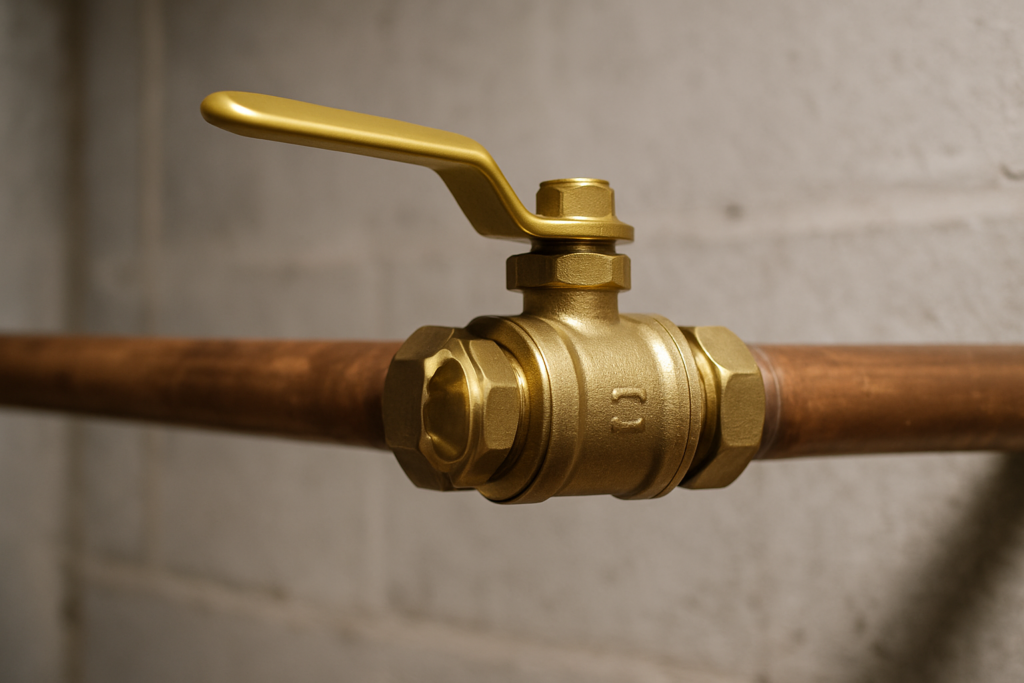
Knowing how to shut off the water to your house is one of the most practically useful things a homeowner can know. A burst pipe, a leaking appliance, or an overflowing toilet can be stopped immediately if you can get to the main shutoff within 30 seconds. Without knowing where it is, you may spend critical minutes searching while water spreads through the floor.
This guide covers where to find the main shutoff valve in Toronto homes, how to operate different valve types, and where the secondary shutoffs are for individual fixtures.
Where Is the Main Water Shutoff in a Toronto Home?
In most Toronto homes, the main water shutoff is in the basement, near the front foundation wall — roughly the same location as your water meter. The supply line enters from the street (which runs along the front of most Toronto properties), comes through the foundation wall, and the shutoff valve is installed on the interior side of that entry point.
If you have a finished basement, look for a utility area, a mechanical room, or a section of exposed wall near the meter. The valve is often within a metre or two of where the water meter is mounted.
Common Variations in Toronto Housing
Semi-detached and row houses: The shutoff is almost always in the basement utility or laundry area near the front of the home.
Detached homes with attached garages: The shutoff may be near the side of the garage if the service entry comes in from a side street.
Condos and apartment units: The unit shutoff is typically inside a mechanical or storage closet within the unit, or occasionally accessible via a panel in a bathroom wall. Contact your building superintendent if you are unsure — they will know exactly where it is for your unit type.
Older homes (pre-1970): Some older Toronto homes have the shutoff valve very close to the meter in a location that may not be obvious. If your home was built before 1970, it’s worth having a plumber point it out during a service visit if you haven’t confirmed it already.
How to Operate the Shutoff Valve
There are two main types of shutoff valves you’ll find in Toronto homes:
Gate Valve (Wheel-Style Handle)
A gate valve has a round, wheel-style handle. Turn it clockwise to close (shut off), counterclockwise to open. Gate valves take multiple full turns to fully close — typically 5 to 10 rotations. They are common in older homes.
Important limitation: gate valves that haven’t been operated in years can be difficult to turn, and the rubber seat inside can fail if they are old. If your gate valve feels stuck, don’t force it — excessive torque can damage the stem. Call a plumber to inspect and exercise it.
Ball Valve (Lever Handle)
A ball valve has a lever handle. When the lever is parallel to the pipe, the valve is open. When the lever is perpendicular (at 90 degrees) to the pipe, it is closed. Ball valves close with a single quarter-turn and are more reliable than gate valves. Most modern installations use ball valves.
The Street-Level Shutoff (Curb Stop)
Outside your home, under a metal access cover in the sidewalk or grass between the sidewalk and the street, there is a curb stop — the city’s shutoff for your supply line. This is the City of Toronto’s responsibility, not yours.
If your interior shutoff is broken, seized, or missing, Toronto Water can shut off at the curb stop. Call 311. This is not something homeowners should operate themselves — the curb stop requires a specialized key tool and operating it incorrectly can damage the valve or the supply line.
Secondary Shutoffs for Individual Fixtures
In addition to the main shutoff, every major fixture and appliance has (or should have) a dedicated shutoff valve. These let you isolate a problem without cutting water to the entire house:
Toilets: Look for an oval-shaped shutoff valve on the wall or floor behind and below the toilet tank, on the supply line feeding the tank. Turn it clockwise to close.
Under-sink faucets: There should be separate hot and cold supply shutoffs under every kitchen and bathroom sink — typically angle stop valves with either oval handles or a screwdriver slot. One valve on the hot supply (left), one on the cold (right).
Washing machine: Hot and cold shutoffs on the wall behind the machine, where the supply hoses connect.
Dishwasher: Usually a shutoff under the kitchen sink on the hot water supply line.
Water heater: A cold water shutoff on the supply pipe entering the top or side of the tank.
Refrigerator ice maker: A small saddle valve or angle stop valve on the cold water line under the sink or in the wall behind the fridge.
What to Do If Your Shutoff Valve Doesn’t Work
Old gate valves sometimes seize fully open and cannot be turned even in an emergency. If you turn the valve and water continues to flow, move immediately to the curb stop (call 311) and then have the interior valve replaced when the water is secured.
If you cannot locate the interior shutoff, call 311 to have Toronto Water shut off at the curb while you deal with the emergency. Then have a plumber install a clearly accessible, properly functioning shutoff as soon as the situation is resolved.
Right Now: Go Check Yours
Find your main shutoff valve today, before you need it. Make sure every adult in the household knows where it is. Confirm that it turns — give it a full close-and-reopen cycle. If it sticks, is corroded, or doesn’t feel right, have it replaced. It is a simple, inexpensive job that takes less than an hour.
ED Plumbing serves Toronto and the GTA. If your main shutoff valve is seized, missing, or needs replacement, call (437) 260-6342. Our TSSA-licensed plumbers can replace or upgrade your shutoff and confirm that all secondary fixture shutoffs are in working order.